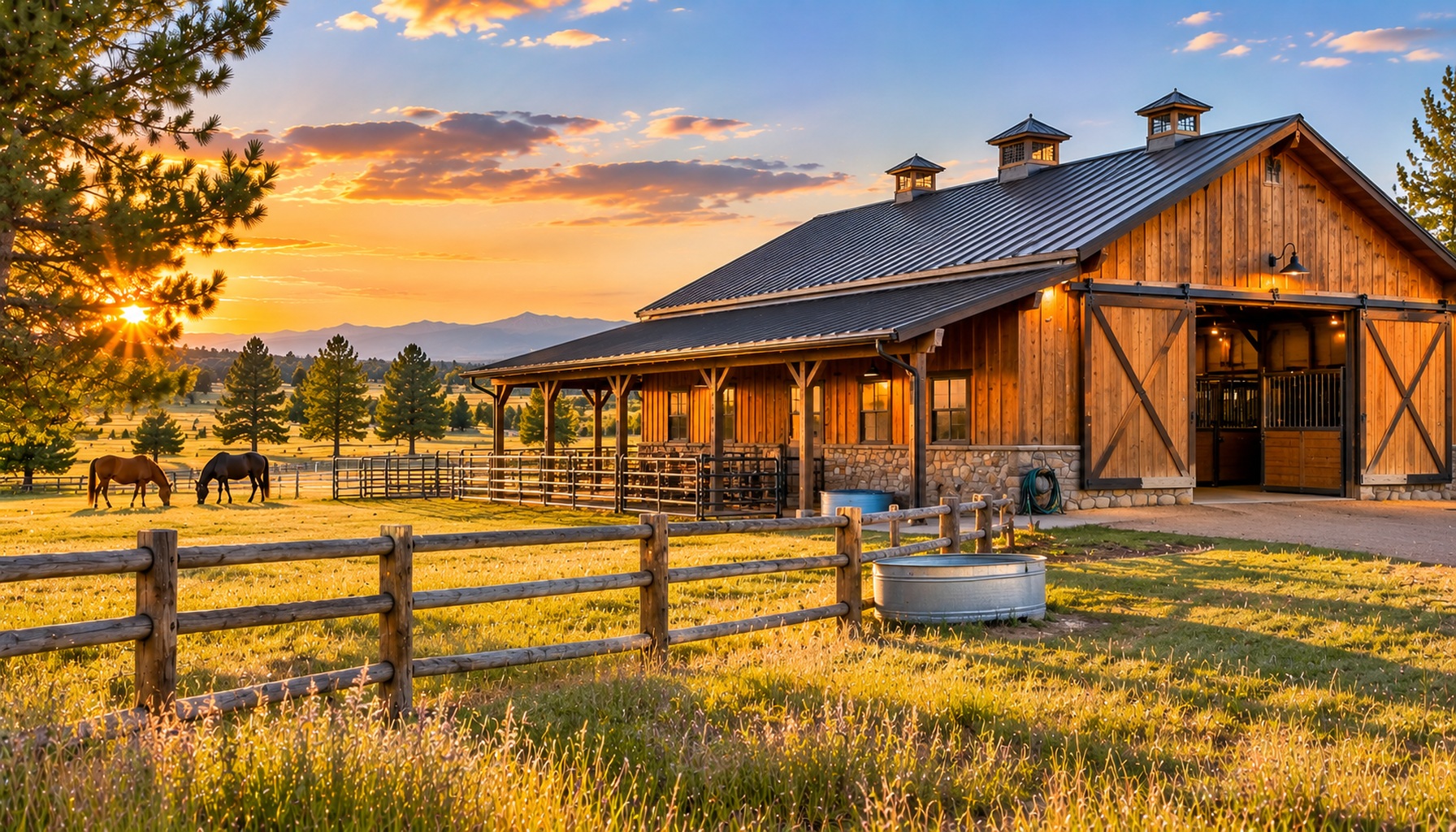
Horse Barn Features That Matter When Buying Acreage in Elbert County
What horse barn features should you look for when buying acreage in Elbert County, Colorado?
The barn features that matter most on Elbert County acreage are structural integrity for Colorado’s snow loads and wind, proper ventilation for dry-climate respiratory health, smart workflow layout, safe stall design, and correct water access for your well permit type.
Why Horse Barn Quality Matters in Elbert County Right Now
If you are shopping for horse property in Elbert County, you already know this is one of the last stretches along the Front Range where you can find 10 to 35 acres without paying Douglas County premiums. But what I have seen over my 23 years working this corridor is that buyers often fall in love with the land and overlook the barn, and that mistake can cost tens of thousands of dollars after closing.
Here is the reality of the 2026 market: inflation and rising construction costs have pushed new custom barn construction up roughly 30% compared to three years ago, per industry market data. A high-end custom horse barn in Colorado can now range from $60,000 to over $100,000 per stall. That means buying a property with an existing, well-built barn is not just convenient. It is a significant financial advantage. With 138 closed transactions and a specialty in horse properties, acreage, and land, I can tell you that getting the barn evaluation right on the front end changes the entire economics of your purchase.
Structural Strength Your Elbert County Barn Must Have
Colorado’s Front Range is not forgiving to poorly built structures. You need a barn engineered for this specific climate, and that means evaluating two non-negotiable factors before anything else.
Snow Load Capacity
Heavy snow loads along the Front Range can exceed 30 pounds per square foot in certain counties, according to regional building data. Your barn’s roof must be rated to handle that weight without sagging, cracking, or worse. When I walk a property with buyers out near Kiowa or along County Road 134, the first thing I look at is the roof structure. A steeper roof pitch allows snow to shed naturally, preventing dangerous accumulation. But here is the detail most buyers miss: the pitch should not dump snow directly in front of stall doors, where it creates ice hazards for you and your horses every morning.
Wind Resistance
Front Range gusts regularly reach 70 miles per hour, per regional weather data. If you have driven down CO-86 toward Elizabeth on a windy day, you know exactly what that feels like. Steel-frame construction offers superior wind resistance and fire resistance, both critical for rural Elbert County properties where fire response times are longer than in the suburbs. Wood barns offer natural insulation and that classic aesthetic, but they require significantly more maintenance. Many experienced builders recommend a hybrid approach: a steel frame with wood-lined interiors that gives you the best of both worlds.
So how do you tell the difference between a barn that was built to last and one that was thrown up cheaply? Let me walk you through what to look for inside.
Interior Barn Features That Protect Your Horses in Colorado’s Dry Climate
The inside of the barn is where your daily life happens, and in Elbert County’s dry, dusty conditions, certain features are not luxuries. They are necessities.
Stall Size and Safety
Standard horse stalls should measure 12 by 12 feet for an average-sized horse, with larger dimensions for drafts. You want durable materials with no sharp edges or protrusions. I always tell my clients to run their hands along every wall surface and check every latch and hinge. Horses are curious, and they will find every hazard you miss during your walkthrough.
Ventilation Systems
This is where Elbert County’s climate creates a unique challenge. Ridge vents are essential because horses need consistent air exchange even in sub-zero temperatures. Colorado’s dry air generates significant dust, and without proper ventilation, respiratory issues in horses become a real and expensive problem. A barn with sealed-up windows and no ridge vents is a red flag, regardless of how pretty it looks.
Flooring That Works
You want textured rubber mats over a crushed stone base. This combination prevents slipping, provides cushion for joints, and withstands the dry climate far better than wood flooring, which cracks and warps in Colorado’s low humidity. Crowned concrete aisles with proper drainage prevent moisture buildup between stalls and keep the workspace functional year-round.
Barn Layout and Workflow Features That Save You Hours Every Week in Elizabeth
Here is something most first-time horse property buyers do not think about until they are living it: the physical layout of your barn determines how much time you spend on daily chores. On a property along County Road 17 outside Elizabeth or on acreage south of Kiowa, you might be managing feeding, mucking, tacking, and hay storage twice a day, every day, in all weather. A thoughtful layout saves you hours every single week.
Key Layout Questions to Ask During Your Walkthrough
- Feed room placement: Is it positioned for easy access from both the stalls and the truck unloading area? Hauling 50-pound feed bags an extra 40 feet every day adds up fast.
- Tack room location: Does it sit near the saddling area so you are not carrying heavy saddles across the barn?
- Water access points: Are there multiple water sources throughout the barn, or just one spigot at the far end?
- Hay storage: Is it close to the stalls but housed in a separate, fire-resistant bay? This is critical in Elbert County, where fire departments serve large rural areas. Keeping hay in a separate structure or fire-resistant section minimizes both dust exposure and fire risk.
- Wash rack: In Colorado’s dusty conditions, a wash rack with proper drainage is essential for maintaining your horses’ skin health.
Barn Orientation
This is a detail that separates a well-designed facility from a generic structure. The ideal barn has its long axis running east to west, which maximizes southern exposure. In a Colorado winter, that southern sun helps melt ice around doorways and provides natural warmth. With 118 five-star reviews and years of helping buyers evaluate horse properties across this corridor, I can tell you that orientation alone can be the difference between a barn that works with the climate and one that fights it.
Water Rights and Well Permits: The Hidden Barn Feature in Elbert County
You might be wondering why a section about water appears in a blog about barn features. The reason is simple: your barn’s functionality is directly tied to your well permit, and in Elbert County, this distinction matters more than almost anything else.
A “Domestic Exempt” well on a parcel of 40 acres or more typically allows for watering livestock and irrigating up to one acre. If you are buying a property under 35 acres, you may receive a “Household Use Only” permit, which strictly forbids watering horses outside the home. That means a beautiful barn with a perfect layout on a 20-acre parcel could be functionally useless for your horses if the water rights do not support livestock use.
This is where working with an agent who specializes in wells, septic, and water rights becomes essential. I have worked this market since 2002 and seen buyers nearly close on properties that would not legally allow them to water their animals. It is one of the most common and most costly oversights in rural horse property transactions. Douglas County requires a minimum of 2.5 acres for the first two horses, but the water permit issue is an entirely separate layer that many agents unfamiliar with rural properties simply do not catch.
What Elbert County Horse Property Costs You in 2026
Understanding the financial landscape helps you evaluate whether a barn is worth what the seller is asking. According to current market research, the Front Range averages $60,000 to $110,000 per acre for developed horse property. A 10-acre horse property in Colorado averages between $800,000 and $1.4 million, with prices in Douglas County often exceeding $1.5 million, per 2026 market data.
In Elizabeth, as of October 2026, the median sale price for closed homes was $644,000, per Resideline data. The middle half of sold prices ranged from $544K to $760K. That slight year-over-year softening of -3.0%, per recent county records, creates an opportunity window for horse property buyers who have been watching the market.
The median active listing in Elizabeth’s 80107 ZIP code has been sitting for 89 days, as of October 2026 per Resideline. That means you have negotiating room, particularly on acreage and horse properties where the buyer pool is naturally smaller. A barn with professional-grade infrastructure in good condition is a premium asset. The math is straightforward: when new custom barn construction runs $60,000 to over $100,000 per stall, an existing four-stall barn in solid condition could represent $240,000 to $400,000 in replacement value.
Frequently Asked Questions
What is the ideal stall size for a horse barn in Elbert County?
Standard stalls should measure 12 by 12 feet for average-sized horses. If you are keeping drafts or larger breeds, you will need bigger dimensions. The stall should have durable, smooth materials with no sharp edges. In Colorado’s dry climate, rubber mats over crushed stone are the preferred flooring choice for joint health and dust management.
Why does barn orientation matter on Colorado acreage?
A barn with its long axis running east to west maximizes southern sun exposure. During Elbert County winters, that southern warmth helps melt ice near doorways and provides natural heating inside the barn. This orientation is especially valuable on the Front Range, where winter sun angles are low but powerful.
How do I know if a barn can handle Colorado snow loads?
Look for engineering specifications indicating the roof can handle snow loads exceeding 30 pounds per square foot. A steep roof pitch allows snow to shed naturally. Steel-frame construction generally offers superior snow load capacity compared to all-wood structures. Always request any available building permits or engineering documentation.
Should I choose a steel or wood barn in Elbert County?
Both materials work in Colorado. Steel barns offer excellent durability against heavy snow loads and are fire-resistant, but they can be noisy and require insulation. Wood barns provide natural insulation and a traditional look but demand more ongoing maintenance. Many builders recommend a hybrid, using a steel frame with wood-lined interiors.
What ventilation features should I look for?
Ridge vents are essential for maintaining air exchange even in sub-zero winter temperatures. Colorado’s dry air generates significant dust, and without proper ventilation, your horses risk respiratory problems. Sealed barns with no ridge vents or operable windows are a serious red flag during your property walkthrough.
How does my well permit affect barn functionality?
A “Domestic Exempt” well on 40 or more acres typically allows livestock watering and irrigation of up to one acre. Properties under 35 acres often carry a “Household Use Only” permit that prohibits watering horses outside. This distinction can make an otherwise perfect barn functionally unusable for equestrian purposes.
Where should hay be stored relative to the barn?
Hay storage should be close to stalls for convenience but housed in a separate, fire-resistant bay or structure. This reduces both dust exposure inside the barn and fire risk, which is especially important in rural Elbert County where fire response coverage spans large areas.
What barn flooring works best in Colorado’s climate?
Textured rubber mats over a crushed stone base are the preferred option. This combination prevents slipping, cushions joints, and handles Colorado’s low humidity far better than wood, which tends to crack and warp in dry conditions. Crowned concrete aisles with proper drainage keep the workspace clean and functional.
How important is a wash rack in an Elbert County barn?
Very important. Colorado’s dusty conditions mean your horses need regular cleaning to maintain skin health. A wash rack with proper drainage is an essential feature, not a luxury. Check that the drainage system routes water away from the barn’s foundation and does not create muddy areas near doorways.
What should I budget for building a barn if the property does not have one?
According to 2026 market data, high-end custom horse barns in Colorado can range from $60,000 to over $100,000 per stall when you factor in premium materials, climate-appropriate construction, and integrated amenities. This makes buying a property with an existing quality barn a significant financial advantage over building new.
The Bottom Line
When you are buying horse property in Elbert County, the barn is not an afterthought. It is the operational heart of your daily life with horses. You need structural integrity built for Colorado’s snow and wind, proper ventilation for our dry climate, a smart layout that saves you time every day, and, critically, water rights that actually allow you to use the barn for its intended purpose.
I have been helping buyers navigate these exact decisions since 2002, and my specialties in horse properties, wells and septic, water rights, and acreage exist precisely because these details are what separate a great purchase from a costly mistake. If you are looking at homes for sale in Elizabeth, searching for acreage in Elbert County, or exploring the broader Front Range corridor, I would love to help you evaluate the full picture. Reach out to me, Marjorie Engle with Engle Homes Group at eXp Realty, at 303-881-2707 to talk through what you need.