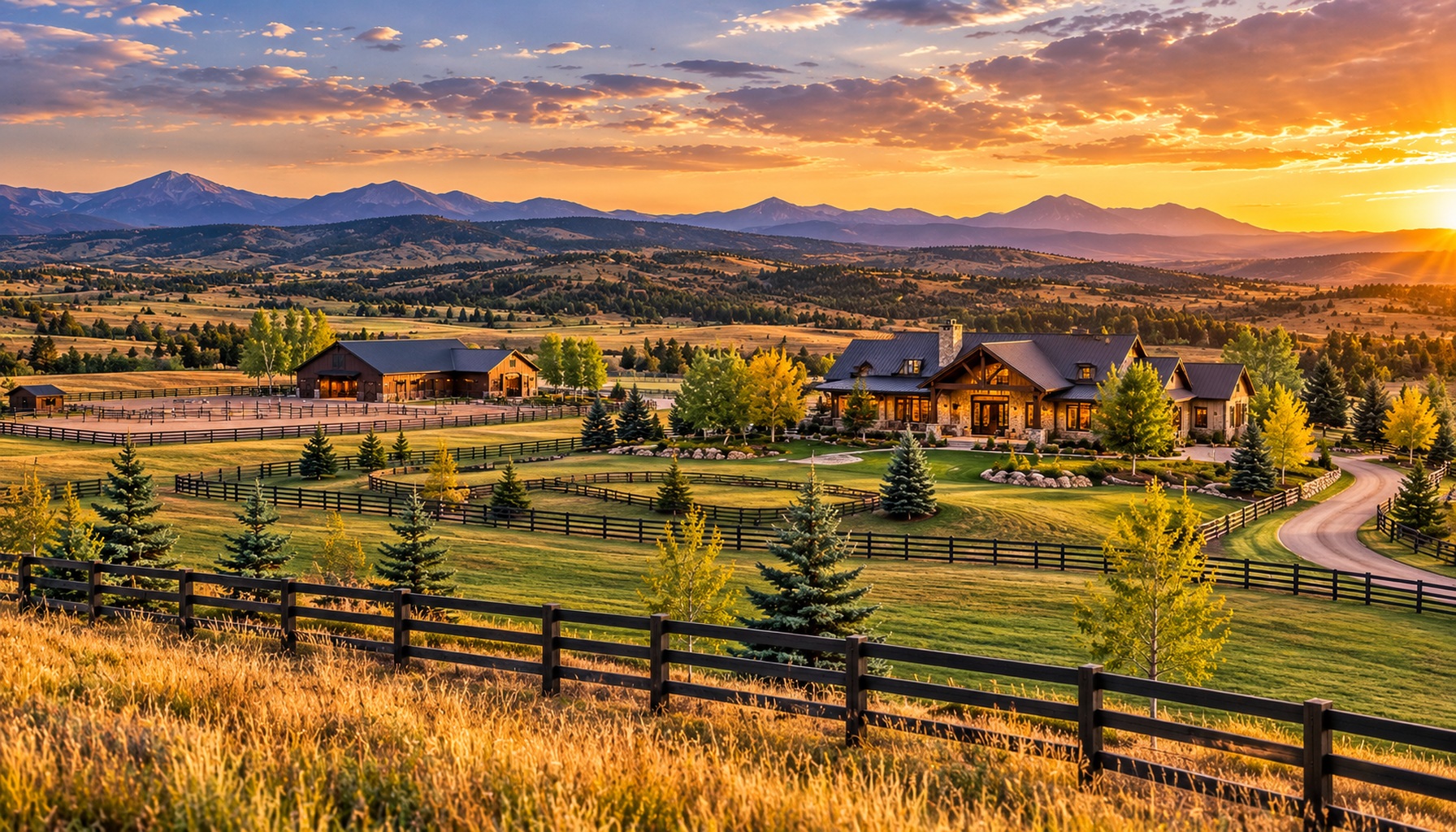
Hidden Carrying Costs of a Luxury Ranch Estate in Douglas County, CO
What hidden carrying costs should I expect when buying a luxury ranch estate in Douglas County, CO, in 2026 beyond the purchase price?
You should budget for property taxes with special district overlays, well and septic maintenance, wildfire insurance premiums, land management, equestrian facility upkeep, and capital reserves that can add $50,000 to $150,000 or more annually to your true cost of ownership.
Why This Matters Right Now in Douglas County and Elbert County
If you are shopping for a luxury ranch estate along the Douglas County and Elbert County corridor, from the rolling acreage south of Parker to the open prairie outside Elizabeth, you already know the purchase price is just the starting line. What catches even experienced buyers off guard is the gap between the number on the closing statement and the real, year-after-year cost of owning a working or lifestyle ranch in this part of Colorado.
With 23 years in Colorado real estate and 138 closed transactions, many of them involving acreage and horse properties in exactly this corridor, I can tell you that the buyers who thrive long term are the ones who build a complete financial picture before they write an offer. The ones who struggle are the ones who fell in love with the view and skip the spreadsheet. Let me walk you through every major carrying cost category so you can plan with confidence.
Property Taxes and Colorado’s Split Assessment System in Douglas County
You might assume property taxes are simple. In Colorado, they are anything but, especially in 2026.
For the 2026 tax year, Colorado uses a split assessment system, per state statute: residential property is assessed at a 6.8% rate for local governments after first reducing the property’s actual value by 10%, capped at a maximum reduction of $70,000. School districts use a different, higher assessment rate. On top of that, a new statutory cap limits how fast most local governments’ total property tax revenue can grow year to year.
What does that actually mean for your ranch budget? Douglas County’s effective property tax rate sits at approximately 0.55%, which is 40% lower than the national average. On a median-priced home valued around $713,600, that works out to roughly $3,947 per year. But luxury ranch estates are not median-priced homes.
Here is where the math gets serious for ranch buyers:
- $2,000,000 property value: Estimated $11,000 to $12,200 per year
- $3,500,000 property value: Estimated $19,250 to $21,350 per year
- $5,000,000 property value: Estimated $27,500 to $30,500 per year
- $8,000,000 property value: Estimated $44,000 to $48,800 per year
Special District Mill Levies: The Hidden Multiplier
Douglas County relies heavily on special districts, including metro districts, fire protection districts, water districts, RTD, and library districts, layered on top of standard county, city, and school levies. Your specific parcel’s combined mill levy from all of these entities determines your actual tax bill. What I tell my clients is this: always request a full mill levy breakdown from the county assessor before you close, because two parcels five miles apart can have dramatically different tax burdens.
Douglas County also follows Colorado’s biennial assessment cycle. The 2025 and 2026 tax years are based on property values as of June 30, 2024, per the Douglas County Assessor. Between 2020 and 2024, the median property tax bill in Douglas County rose 32.4%, from $2,980 to $3,947, according to PropertyTaxByState. When the next reassessment hits, your luxury property value could push your bill even higher.
Insurance Costs for Ranch Properties Near Elizabeth and Parker
You will not insure a luxury ranch estate the way you insure a home in a Parker subdivision. Not even close.
Many ranch properties in Larkspur, Sedalia, and the western and southern stretches of Douglas County sit within wildland-urban interface zones, meaning wildfire risk directly shapes your premiums. Since the Marshall Fire in 2021, Colorado’s wildfire insurance market has tightened significantly. Carriers have either pulled out of high-risk areas or raised rates sharply.
Here is what you need to budget for:
- Primary dwelling coverage on a high-value home: premiums reflect both replacement cost and fire zone designation
- Outbuilding and barn coverage: Separate policies or endorsements for barns, arenas, equipment storage, and hay sheds
- Liability coverage: Large acreage with livestock, equestrian activities, or guest access demands umbrella policies well above standard limits
- Estimated annual premiums: For a $3M to $5M luxury ranch estate, annual insurance can range from $8,000 to $25,000 or more, depending on wildfire zone, outbuildings, and coverage limits
What I always recommend is getting quotes from at least three carriers familiar with Colorado rural properties before you finalize your purchase. This is not an area to guess on.
Well, Septic, and Water Rights in Douglas County and Elbert County
Most ranch properties in this corridor are not on municipal water or sewer. If you are coming from Parker or Castle Rock where city utilities are standard, this is a mindset shift, and a budget line you need to take seriously.
Well System Costs
- Annual water testing: $200 to $500
- Pump replacement (every 8 to 15 years): $3,000 to $10,000 or more
- Well deepening if water tables drop: costs vary significantly by depth
Septic System Costs
- Pumping every 2 to 3 years: $400 to $800
- Inspections and maintenance: annual or biennial
- Full replacement (engineered systems on large properties): $15,000 to $40,000
Water Rights and Augmentation Plans
Colorado water law is genuinely complex. Some wells require augmentation plans through a water conservancy district, which can add $500 to $2,000 or more annually. Some ranch properties come with irrigation rights, live water creeks, and producing hay meadows, but maintaining and adjudicating those rights involves ongoing legal and administrative costs. With 23 years specializing in rural Colorado real estate, including buying acreage in Elbert County and throughout the ranch corridor, I have seen water rights become the single most overlooked carrying cost for luxury ranch buyers.
Land Management, Wildfire Mitigation, and Grounds Maintenance
Owning 35 to 200 acres of Colorado rangeland is not passive. The land demands attention, and the county expects you to manage it responsibly.
- Fencing repair and replacement (35 to 100+ acres): $3,000 to $15,000 per year
- Noxious weed control (county-mandated): $2,000 to $8,000 per year
- Private road and driveway maintenance (gravel, grading): $2,000 to $10,000 per year
- Wildfire mitigation (defensible space, tree thinning): $3,000 to $15,000 per year
- Snow removal for private roads and driveways: $2,000 to $6,000 per year
- Pasture management and reseeding: $1,500 to $5,000 per year
- Landscaping and grounds maintenance: $5,000 to $25,000 or more per year
Head south on County Road 21 outside Elizabeth and you are in true ranch territory, the kind of land I have been helping buyers evaluate since 2007. The maintenance costs are real, but they are manageable when you plan for them. The buyers who get surprised are the ones who thought a ranch runs itself.
Equestrian Facility and Agricultural Carrying Costs
If your ranch includes equestrian facilities (and many luxury estates near Elizabeth, Parker, and across Douglas County do, with covered arenas, barns with 22 or more stalls, and fenced pasture), your carrying costs expand considerably.
- Barn maintenance and repairs: $3,000 to $10,000 per year
- Arena footing replacement and maintenance: $2,000 to $8,000 per year
- Hay and feed (per horse, with 2 to 6 horses typical): $3,000 to $6,000 per horse per year
- Farrier, vet, and equine insurance: $3,000 to $8,000 per horse per year
- Manure management: $1,500 to $4,000 per year
- Facility insurance (barn, arena): $2,000 to $6,000 per year
So, are you looking at a true working equestrian property or a lifestyle estate? The answer changes your annual budget by tens of thousands of dollars.
Utilities, HOA Fees, and Financing Costs for Douglas County Ranch Estates
Utilities on Large Acreage
Rural properties carry utility profiles that differ from suburban homes:
- Electricity (outbuildings, heated barns, arena lighting): $500 to $1,500 per month
- Propane (many rural properties rely on it for heating a 5,000 to 10,000 sq ft home plus outbuildings): $5,000 to $15,000 per year
- Internet and connectivity: Satellite or fixed wireless, roughly $100 to $300 per month with potential installation fees
HOA and Covenant Fees
Some luxury ranch communities in Douglas County, such as Perry Park Ranch and Sweetwater Ranch, carry HOA dues of $500 to $3,000 per year, plus road maintenance assessments and architectural review requirements that add cost to any modifications.
Jumbo Mortgage Realities
With average 30-year fixed rates around 6.67% as of August 2026 per Freddie Mac’s national survey, and Colorado lenders quoting roughly 6.6% to 6.8% depending on credit profile, a $2.4M jumbo loan (20% down on a $3M purchase) generates principal and interest payments of approximately $15,500 to $16,000 per month. Jumbo loans also carry larger down payment requirements (typically 20% to 30%) and more stringent appraisal standards for rural and agricultural properties.
Capital Reserves You Cannot Afford to Ignore
Large estate properties demand a dedicated capital reserve fund for inevitable big-ticket replacements:
- Roof replacement (main home plus outbuildings, every 15 to 25 years): $30,000 to $100,000 or more
- HVAC systems (multiple units for large homes): $10,000 to $30,000 per replacement
- Driveway repaving or regrading: $10,000 to $50,000
- Well pump or system overhaul: $5,000 to $15,000
- Septic system replacement: $15,000 to $40,000
Frequently Asked Questions About Luxury Ranch Carrying Costs in Douglas County
How much are property taxes on a $3 million ranch in Douglas County in 2026?
Douglas County’s effective property tax rate is approximately 0.55%. On a $3 million property, you can estimate roughly $16,500 to $18,300 per year. However, special district mill levies layered onto your specific parcel can push that number meaningfully higher. Always request a full mill levy breakdown before closing.
Why is ranch insurance so expensive in Douglas County?
Many ranch properties sit within wildland-urban interface zones where wildfire risk is elevated. Since the 2021 Marshall Fire, carriers have tightened coverage and raised premiums across Colorado. Barns, arenas, and equestrian facilities also require separate or supplemental policies that standard homeowners coverage does not include.
Do I need a well and septic system on a Douglas County ranch?
Most ranch properties in Douglas County and Elbert County are not connected to municipal water or sewer. You will rely on a private well and septic system, both of which carry ongoing testing, maintenance, and eventual replacement costs that can total several thousand dollars annually.
What are water augmentation plans and do they cost money?
Under Colorado water law, some wells require augmentation plans administered through a water conservancy district. These plans can add $500 to $2,000 or more per year. If your ranch includes irrigation rights or live water, legal and administrative costs for maintaining those rights add another layer.
How much does it cost to maintain fencing on a 40-acre ranch?
Fencing repair and replacement on a 35 to 100 acre property typically runs $3,000 to $15,000 per year, depending on fence type, terrain, and livestock requirements. Colorado weather, including heavy snow and high winds, accelerates wear on both wood and wire fencing.
What is wildfire mitigation and is it required?
Wildfire mitigation involves creating defensible space around structures, thinning trees, and managing vegetation. While not always legally required, many insurance carriers mandate it for coverage, and Douglas County strongly recommends it. Annual costs range from $3,000 to $15,000 depending on acreage and vegetation density.
How much do equestrian facilities add to annual carrying costs?
A ranch with a barn, arena, and capacity for 2 to 6 horses can add $20,000 to $60,000 or more per year in facility maintenance, feed, veterinary care, farrier services, manure management, and facility insurance. The exact number depends on the scale of your operation.
Are there HOA fees on luxury ranch properties in Douglas County?
Some ranch communities, including Perry Park Ranch and Sweetwater Ranch, carry HOA fees of $500 to $3,000 per year, plus road maintenance assessments. Other unincorporated parcels have no HOA but still require private road maintenance at your own expense.
What capital reserves should I set aside for a luxury ranch estate?
Plan for roof replacement ($30,000 to $100,000 or more across all structures), HVAC replacement ($10,000 to $30,000 per system), driveway work ($10,000 to $50,000), well pump overhaul ($5,000 to $15,000), and septic replacement ($15,000 to $40,000). A dedicated reserve fund prevents these inevitable costs from becoming emergencies.
How do I get an accurate picture of total carrying costs before I buy?
Work with an agent who specializes in acreage and ranch properties in this specific market. Request a full mill levy breakdown, get insurance quotes from carriers experienced with rural Colorado, commission a well and septic inspection, and review any HOA or covenant documents in detail. With 118 five-star reviews and deep specialization in this corridor, I walk every ranch buyer through this process step by step.
The Bottom Line
Buying a luxury ranch estate in Douglas County or Elbert County is one of the most rewarding real estate decisions you can make, but only when you go in with your eyes wide open. The purchase price is the beginning, not the end. Understanding what all the costs of buying a home entail helps you plan better for your full financial picture. Property taxes, insurance, well and septic systems, land management, equestrian facilities, utilities, and capital reserves can collectively add $50,000 to $150,000 or more per year depending on the size and scope of your property.
I have spent 23 years helping buyers navigate exactly these decisions across Elizabeth, Parker, and the surrounding ranch corridor. My experience with acreage, horse property, and land sales means you get honest guidance on the full cost of ownership, not just the closing table. If you are seriously considering a luxury ranch in this market, contact me to discuss your options. Let’s build your complete financial picture before you fall in love with the land.