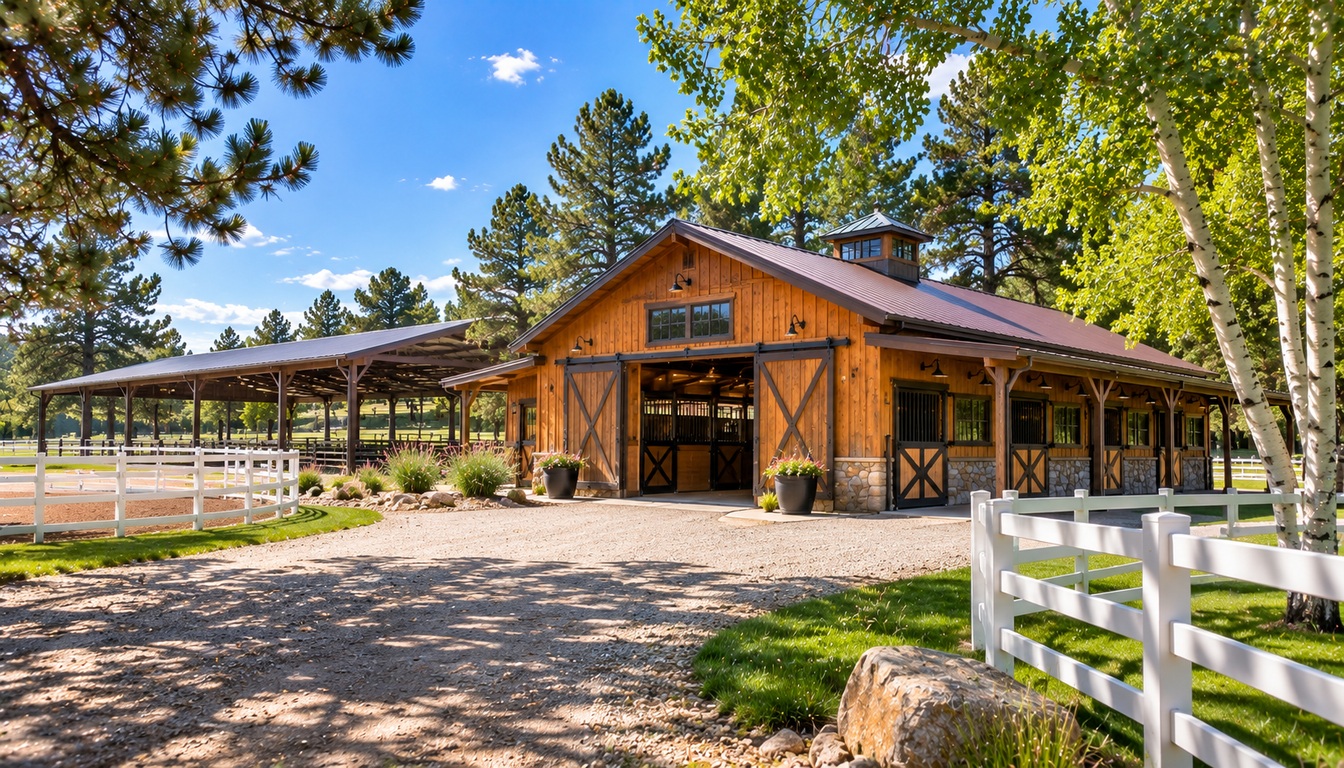
Living in Franktown, Colorado: What Makes This Rural Enclave So Different
What makes living in Franktown, Colorado, genuinely different from nearby communities like Parker, Castle Rock, and Elizabeth?
Franktown is a deliberately small, unincorporated Douglas County community of roughly 400 people where equestrian estates on 5 to 57 acres replace subdivisions, private wells replace municipal water, and the Palmer Divide’s pine-covered hills keep the landscape green and rural despite being ten minutes from Parker.
Why Franktown Matters for Colorado Homebuyers Right Now
If you are searching for homes in Douglas County in 2026, you already know the market has layers. As of August 2026, the Douglas County median sale price sits at $720,000 (up 0.5% year over year), per Douglas County census data. But that number masks what is actually a two-market county. On one side, you have the suburban subdivisions of Highlands Ranch and Parker. On the other, you have Franktown, where the median home price exceeds $1.1 million, according to local MLS transaction data, and typical lots start at five acres.
So why does this matter to you right now? Because inventory remains tight across the Front Range. Homeowners who locked in pandemic-era rates between 2.5% and 3.5% are staying put, and that means the buyers actively looking at Franktown properties in 2026 are making intentional, lifestyle-driven decisions, not casual upgrades. Homes in Franktown spent a median of 90 days on the market in mid-2026, which tells you this is a community where patience and preparation pay off.
Franktown’s Equestrian Identity Sets It Apart from Castle Rock and Parker
You will not find a community on the Colorado Front Range that matches Franktown’s concentration of professional equestrian infrastructure. This is not a neighborhood where someone keeps a couple of horses in the backyard. Franktown is recognized as one of the premier equestrian addresses on the entire Front Range, and the infrastructure reflects it.
Properties routinely feature multiple-stall barns, covered arenas, outdoor riding areas, round pens, hay storage, and fenced pastures. At the upper end, 35 to 57 acre parcels can support hay production, larger training or breeding operations, and maximum privacy. Some include multiple wells, secondary homes, or caretaker’s quarters.
The proximity to the Colorado Horse Park creates a full professional ecosystem: trainers, farriers, equine veterinarians, feed suppliers, and barn managers all operate in the immediate area. Franktown is known specifically for high-level English disciplines, including Hunter/Jumper, Dressage, and Eventing. Castlewood Equestrian Center alone is a 151-acre full-scale boarding and training facility with capacity for 130 horses.
What I tell my clients who are relocating from out of state is this: if you are serious about your equestrian program, Franktown means your trainer is five minutes away, not an hour. That changes your daily life completely.
The Deliberate Ruralism of Franktown: No Traffic Lights, No Big-Box Retail
Here is what you need to understand about Franktown before you start your home search: this community chose to stay small. Founded in 1859 and once the original Douglas County seat, according to local historical records, Franktown has deliberately resisted large-scale commercial development while the rest of Douglas County exploded with subdivisions.
The town center consists of little more than a cafe, a general store, a historic post office, and a volunteer fire station. The community landmarks tell you everything about the values here: self-reliance, neighborliness, and a deep commitment to preserving rural character.
You will shop in Parker (ten minutes north on Highway 83) or Castle Rock (about ten minutes to I-25). Franktown Community Church serves as a de facto town anchor. The old Franktown Town Hall at the highway intersection marks the center of this unincorporated community.
Does that lifestyle appeal to you, or does it concern you? That is the first and most important question to answer honestly before you look at a single listing. Having worked in Colorado real estate since 2002 and closed over 138 transactions across Elbert County, Douglas County, and surrounding communities, I can tell you that Franktown buyers who thrive here are the ones who walk in with their eyes wide open about what the community does and does not offer.
What Franktown Does Not Offer (and Why Relocation Buyers Need to Know)
If you are relocating from a metro area, you need an honest picture. Franktown does not offer municipal water and sewer on every property. Most properties rely on private wells and septic systems. Well permits control your legal water use. Septic systems require specialized inspection. You will not find direct light rail or RTD transit service, a traditional downtown with substantial retail, or a broad inventory of entry-level condos, townhomes, or small-lot homes.
What does this mean practically?
- Internet quality should be verified by exact address before you make an offer
- Gravel roads and private roads can affect daily driving and winter maintenance
- Highway 83 and Highway 86 are your key commute routes
- Commute to Denver Tech Center: approximately 45 to 55 minutes via Highway 83 North or I-25 and E-470
- Commute to Denver CBD: 55 to 70 minutes
This is a drive-everywhere community, and that is part of its appeal for buyers seeking acreage and privacy. With 23 years of experience serving this area, I have deep expertise in wells and septic, water rights, and large-acreage properties. These are not details you want to learn about after closing.
The Palmer Divide Effect and Franktown’s Natural Setting
One of Franktown’s most distinctive features is something you cannot see on a listing sheet. Franktown sits right on the Palmer Divide, the low ridge that separates the South Platte watershed (which flows toward Denver) from the Arkansas watershed (which flows toward Colorado Springs). This geographical feature has practical, daily implications for your life here.
Winter storms often drop six inches in Franktown while Denver sees a dusting. Locals call this “the Palmer Divide effect,” and it is the reason the area’s ranches tend to stay green well into July. The ponderosa pines of the Black Forest reach their westernmost extension here, giving Franktown a genuine mountain-town feel at roughly 6,000 feet of elevation, despite the lack of any actual mountains.
Castlewood Canyon State Park, a 2,303-acre expanse just east on Highway 86, offers scenic nature trails, technical rock climbing, and exceptional bird-watching. Cherry Creek flows through the broader area, connecting to regional open space. When people ask me what Franktown feels like, I describe it this way: pine-covered hills, massive mesas with Front Range views, and a sky that goes on forever.
How Franktown Compares to Elizabeth, Parker, and Castle Rock for Homebuyers
You are probably weighing Franktown against several nearby communities, and I help buyers work through this comparison constantly. Here is the honest breakdown:
- Franktown: Rural and equestrian. Typical lots 5 to 57+ acres. Private wells and septic. Minimal retail. Median home price exceeding $1.1 million. About 10 minutes off I-25.
- Castle Rock: Suburban and growing. Typical lots 0.1 to 1 acre. Municipal utilities. Extensive retail. Median home price roughly $600,000 to $800,000. Direct I-25 access.
- Parker: Suburban. Typical lots 0.1 to 0.5 acres. Municipal utilities. Extensive retail. Median home price roughly $550,000 to $750,000. About 15 minutes to I-25.
- Elizabeth: Small-town and rural. Mixed lot sizes from quarter-acre to 35+ acres. Mixed utility infrastructure. Limited retail. Median closed sale price of $644,000 over the last six months as of October 2026, based on tracked closings.
If you want acreage and a serious equestrian lifestyle within Douglas County, Franktown is your answer. If you want more retail access and a suburban feel at a lower price point, Parker and Castle Rock serve that need. Elizabeth offers a middle ground with a small-town community feel across the county line in Elbert County.
Schools and Family Life in the Franktown Corridor
Franktown Elementary School serves grades PreK through 5 and enrolls about 354 students with a student-to-teacher ratio of 17.7 to 1. The school offers a Gifted and Talented program and benefits from strong parent involvement.
For middle and high school, your children will feed into other Douglas County School District options, including highly-rated schools in Castle Rock and Parker. The DCSD district encompasses 90 schools across 850 square miles and maintains a graduation rate of 93.6%, per district data. That combination of a small, community-centered elementary school with access to a larger, well-resourced district is something families find compelling.
Frequently Asked Questions About Living in Franktown, Colorado
What is the median home price in Franktown in 2026?
The median home price in Franktown exceeds $1.1 million, and properties regularly list at $1.8 million and above, according to local MLS data. There have been 105 transactions over the past year with a median residential transaction value of $1,118,786. This is a luxury and lifestyle market, not a starter-home neighborhood.
How long do homes in Franktown typically take to sell?
Homes in Franktown spent a median of 90 days on the market in mid-2026. Typical average days on market run around 175 days for larger properties. These are deliberate, lifestyle-driven purchases, and both buyers and sellers take their time negotiating custom and equestrian properties.
Does Franktown have municipal water and sewer?
No. Franktown is unincorporated Douglas County, and most properties rely on private wells and septic systems. Well permits control your legal water use, and septic systems require specialized inspection. Working with a Realtor who understands wells, septic, and water rights is essential here.
How far is Franktown from Denver?
Franktown is approximately 25 miles southeast of Denver. Your commute to the Denver Tech Center runs about 45 to 55 minutes via Highway 83 North or I-25 and E-470. The commute to downtown Denver is roughly 55 to 70 minutes depending on traffic.
What makes Franktown’s equestrian community special?
Franktown is recognized as one of the premier equestrian addresses on the entire Front Range, with a concentration of professional barns and trainers among the highest in the area. The proximity to the Colorado Horse Park creates a full ecosystem of trainers, farriers, equine veterinarians, and feed suppliers.
What is the population of Franktown?
Franktown has a 2026 population of approximately 407 people. The community has deliberately stayed small, and the median household income is $250,001 with a median age of 55.8 years, per Elbert County census data.
Are there good schools near Franktown?
Yes. Franktown Elementary School serves PreK through 5 with a student-to-teacher ratio of 17.7 to 1. Older students feed into the Douglas County School District, which maintains a 93.6% graduation rate across 90 schools.
What is the Palmer Divide and how does it affect Franktown?
The Palmer Divide is the low ridge separating the South Platte and Arkansas watersheds. It causes Franktown to receive significantly more snowfall than Denver, keeps the landscape greener through summer, and is a primary reason the area has remained rural.
How does Franktown compare to Castle Rock for homebuyers?
Castle Rock offers suburban living with municipal utilities, extensive retail, and direct I-25 access at a median price range of roughly $600,000 to $800,000. Franktown offers rural estate living on 5 to 57+ acres at a median exceeding $1.1 million, with private wells, septic, and minimal commercial development.
What outdoor recreation is available near Franktown?
Castlewood Canyon State Park covers 2,303 acres just east on Highway 86 and offers hiking trails, technical rock climbing, and bird-watching. Cherry Creek flows through the broader area connecting to regional open space networks.
The Bottom Line on Living in Franktown
Franktown is not for everyone, and that is exactly the point. If you want acreage, privacy, an equestrian lifestyle, Front Range views, and a community that has intentionally preserved its rural character for over 160 years, you will not find a better address in Douglas County. If you need walkable retail, short commutes, and municipal infrastructure, nearby Parker and Castle Rock deliver those things well.
The key to buying successfully in Franktown is working with someone who understands the nuances of wells, septic, water rights, horse property infrastructure, and the local market dynamics that make this corridor unique. With 23 years of experience across Elbert County and Douglas County, 138 closed transactions, and 118 five-star client reviews, I have built my career helping buyers navigate exactly these decisions. If you are considering Franktown or any community along the Highway 83 and 86 corridor, I would love to talk through what makes sense for your situation. Call me, Marjorie Engle with Engle Homes Group at eXp Realty, at 303-881-2707.